

Blue-green infrastructure
How Eawag wants to make cities climate resilient
Heavy rain and heat are increasingly causing problems, even in Switzerland, potentially leading to devastating floods and excess mortality. To counteract these effects, Eawag is researching blue-green infrastructure, which is designed to prepare our cities for climate change.
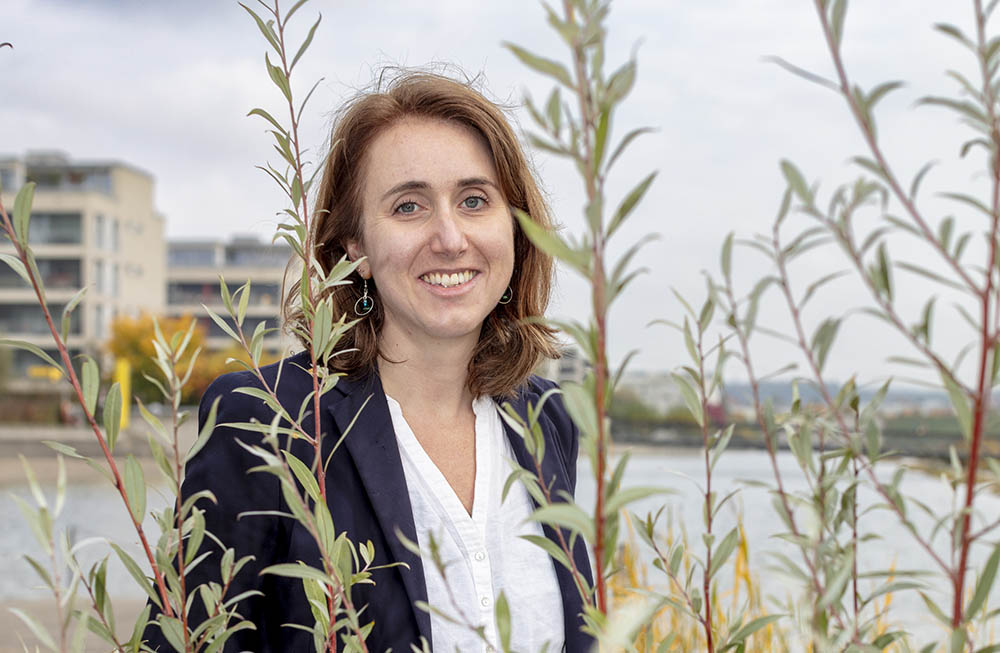
Closed roads, mud flows and flooding: in July and August 2025, heavy rain repeatedly caused chaotic conditions in various regions of Switzerland. Earlier in the year, a heatwave had swept across the country, prompting the Federal Office of Public Health (FOPH) to warn of health risks. Events of this kind are likely to increase in the future. The scientific community is called upon to work on solutions to these challenges. That’s precisely the role of Lauren Cook. As a civil and environmental engineer, she completed a doctorate at Carnegie Mellon University in the USA and joined Eawag seven years ago. She and her colleagues are researching blue-green infrastructure, also known as the sponge city approach.
Sponge city
Blue-green infrastructure refers to urban landscapes that absorb, store and release water. The aim is to restore the natural water cycle in the city, making it possible to tackle several problems at once. More vegetation and permeable surfaces help to retain rainwater where it falls – instead of channelling it into the sewer system without actually using it. Plants and soil in turn act like sponges by absorbing water, storing it temporarily and then slowly releasing it again. This not only relieves the sewer system, but also purifies the water before it returns to the natural cycle. At the same time, green spaces and evaporation help to cool down cities
“Both heat and heavy rainfall are set to increase due to climate change,” says Cook. “Sponge cities are a solution for adapting to climate change.” Elements of blue-green infrastructure include green roofs, ponds, urban wetlands, rain gardens and permeable paving. Concepts of this kind are being implemented more and more frequently in Switzer-land – for example in Zurich’s Greencity district in the Sihl Valley, where rainwater is drained off and retained on site. Initial pilot projects are also under way in Basel and Lausanne.
Cook’s team has tested the practical implementation of solutions in various locations, including on Eawag’s own roofs. Over a period of five years, the researchers investigated how different types of vege-tation and combinations of techniques – for instance using solar panels – affect cooling, water retention and energy efficiency. However, a large part of Cook’s work takes place on computers rather than on roofs. She uses models to simulate how blue-green infrastructure performs in different climate scenarios – with higher temperatures, longer periods of drought or heavier rainfall. The aim is to find out which combinations are most effective and how they can be integrated into existing urban structures.

“We are all researching a climate-resilient future. Sponge cities are a solution for adapting to climate change.”
— Lauren Cook
It almost goes without saying that multiple disci-plines have to come together to achieve this objec-tive. “Sponge cities touch on engineering, ecology, social sciences, architecture – no single subject can cover every aspect,” says Cook. Wherever water areas and vegetation are created, habitats also develop – for insects, birds and plants. At the same time, social questions arise: how safe, how attractive and how accepted are these spaces? Conflicts of interest are inevitable. Do people in the local area feel disturbed by greater numbers of insects, for instance?
What is more, even blue-green infrastructure is not CO2-neutral, as all infrastructure causes emissions during construction. “But it offers many advantages,” says Cook. “Ultimately, it’s about weighing up and prior-itising.” Eawag relies on laboratories known as living labs to help understand this balance between costs and benefits. These real-world laboratories enable researchers to work with cities and residents to observe how blue-green infrastructure systems function in everyday life.
At the same time, Switzerland is part of a global learning process. “Climate change is turning everything upside down,” says Cook. “Our previous assumptions about infrastructure planning no longer apply. Blue-green infrastructure can help because of its flexibility.” Eawag is gaining experience in planning and maintaining this type of system from partners in the USA, Australia and Canada.
Conversely, knowledge from Switzerland – for example on biodiversity, water protection and ecological urban development – flows back into global networks. Cook is endeavouring to bring research and engine-ering practice closer together – so that the ideas from the laboratories and models actually find their way into real life. “We need to develop solutions that don’t just work in theory, but can actually be put into practice,” she says. This will make sure that our cities are ready for the future.