

Area monitoring by Swiss Forest Protection
The “tree doctor” who protects forest health
As a boy, Valentin Queloz used to love spending time in the forest. Today, his childhood playground is his place of work. As the “Group leader Swiss Forest Protection” at WSL, he is responsible for the “area monitoring” nationwide early-warning system.
When Valentin Queloz attends specialist conferences, he sometimes meets microbiologists who study the human microbiome. That’s when he realises: “We actually deal with very similar issues. A healthy forest is like a healthy person:
it needs a stable microbiome with lots of different things working together.”
Queloz, who is from French-speaking Switzerland, also has good reason to be pessimistic: climate change is encouraging the spread of various pests. “As coldblooded organisms, some native beetles are benefiting from the higher temperatures and reproducing more now than in the past. The milder winters are also allowing Mediterranean species to become established,” explains Queloz. At the same time, the number of organisms being introduced into our forests is increasing exponentially.
Swiss Forest Protection
works with the cantonal forestry services to assess the occurrence and extent of biotic and abiotic damage to forests, provides information on current forest protection issues, advises those affected on forest protection matters, and is involved in the further training of forestry services, the green sector, students and other specialist staff.
WSL is countering this development by means of area monitoring – a nationwide early-warning system designed to protect Swiss forests from harmful invasive organisms. The research centre does not want to delay the discovery of dangerous species until they have already eaten their way through half a forest. The idea is to focus on prevention rather than treatment. “In the past, you simply reported on what
you had found,” says Queloz. “Today we search specifically and can say: we’ve checked and it’s not there.” Eight target species on the EU’s quarantine list are being monitored – including the Asian longhorned beetle, the emerald ash borer and the pinewood nematode, as well as two fungal diseases, phytophthora ramorum (which causes sudden oak and larch death) and pine pitch canker.
Insects are caught in funnel traps in the treetops at 75 monitoring sites in 16 cantons, and spores are also collected. Forest protection officers from the cantons, often foresters or forest engineers, empty the traps every month during the spring/ summer and send the contents to WSL. Around 600 to 1,000 samples are gathered each year. “We sort the sample contents and search for the target species. We also check whether non-native, non-listed species are present in the samples,” says Queloz.
“This makes us the hub between research, politics and practice.” Queloz’s group is working with experts from the Phytopathology and Forest Entomology groups to investigate how different species spread into Switzerland, and is testing DNA analyses to identify new species in trace material more quickly. “In the future, we want to be able to read from a kind of genetic soup to work out which insects or fungi are on the move.” These methods are still complex and expensive. “But we are continuing our research to make them more economical and efficient,” says the scientist.

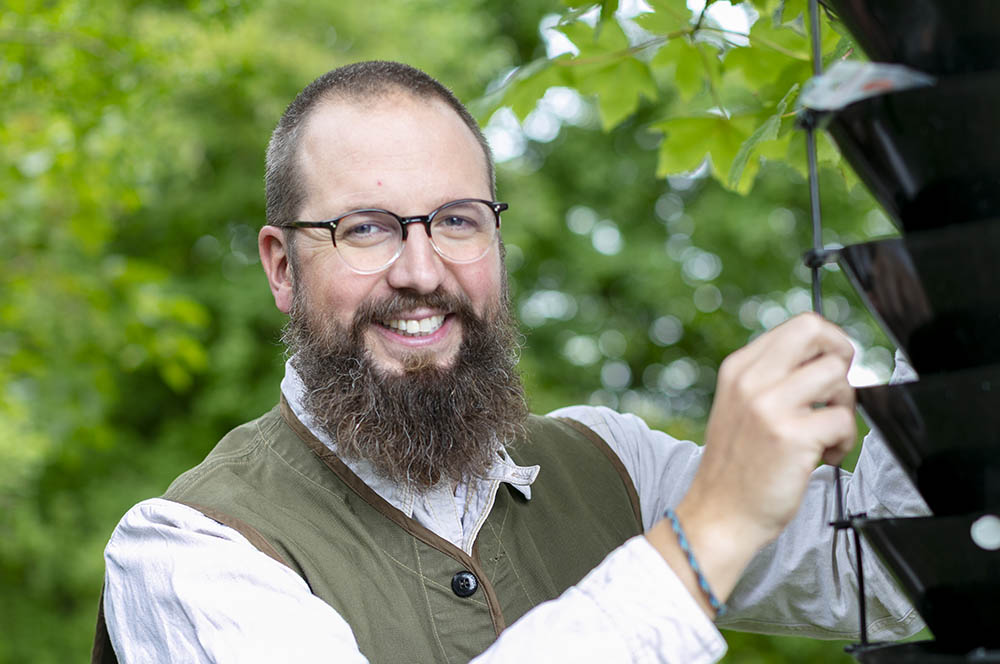
Valentin Queloz in Oberwinterthur, a monitoring area in the Canton Zurich.
Valentin Queloz does not believe that the forests will disappear, but thinks that their benefits will change. “The big question is what we expect from them. Should they store CO₂, filter water or provide protection? We have to act accordingly.”
— Valentin Queloz
His team is just as diverse as the task itself. Biologists, forest engineers, data analysts, laboratory technicians – everyone plays their part in ensuring that invasive organisms do not become established in Switzerland unnoticed. The system only works because the cantons support it. They look after the forest areas, while WSL supplies the material and instructions on how to empty the traps.
However, if the presence of organisms on the quarantine list is suspected, Queloz and his team go out and assess the situation on site themselves and prevent any pests from spreading further as a result of human intervention. He is particularly pleased when the knowledge gained from research has a direct impact. “Professionals who have attended our courses and lectures often report suspicious forest protection cases from their everyday lives. This indirectly increases the monitoring density,” explains Queloz.
“That gives us a sense of achievement. And contributes to our prevention efforts.”
Once a year, all the forest protection officers meet up with the Federal Office for the Environment (FOEN) and WSL. “Everyone works well together,” emphasises Queloz. “At the end of the day, we all want the same thing: healthy forests.”
The boy who used to roam the woods as a child has become a researcher who has retained his fascination for this ecosystem – and all its facets: “We work with disease and death,” he says, “but this often helps us to make the forests more attractive. When bark beetles destroy spruce trees in the Swiss Mittelland, hardwood grows back and adds to the diversity of the forest.” And as a researcher, he is of course delighted when he discovers a new species of fungus, even if it is harmful to trees.
“We sometimes have to curb our enthusiasm a little in the field,” says Queloz, who has professional experience in forestry himself. He graduated in forest engineering from ETH Zurich and specialised in forest health and fungal diseases early on. He wrote his dissertation on root fungi on spruce trees and ash dieback – topics that have stayed with him to this day. Before joining WSL, he was responsible for forest protection in the Canton of Jura alongside his research activities at ETH Zurich. This dual function between research and practice stands him in good stead today. When the opportunity arose to take on a full-time position at WSL in 2015, he jumped at the chance: “It was a perfect fit for my career.”