


Key findings of the consultation
The consultation on two versions of FIT for the Future took place within the ETH Domain between March and June 2026. The great majority of the opinions expressed were in favour of the “Swiss National Labs” (SNLs) option.
In March 2026, the ETH Board decided to put forward two versions of the organisational development project FIT for the Future for internal consultation within the ETH Domain. They differ mainly in the degree to which the four research institutes are integrated. In the version with the working title “Swiss National Labs” (SNLs), the four research institutes retain their individual legal personalities. In the “Swiss National Lab” (SNL) version, they are merged into a shared legal personality. In both cases, the research institutes retain their names, logos and sites. They are also given a joint name.
The Executive Boards and university assemblies of ETH Zurich and EPFL, and the Directorates and staff representatives of the four research institutes, were invited to evaluate the two options based on a list of questions.
Big majority in favour of the SNLs option
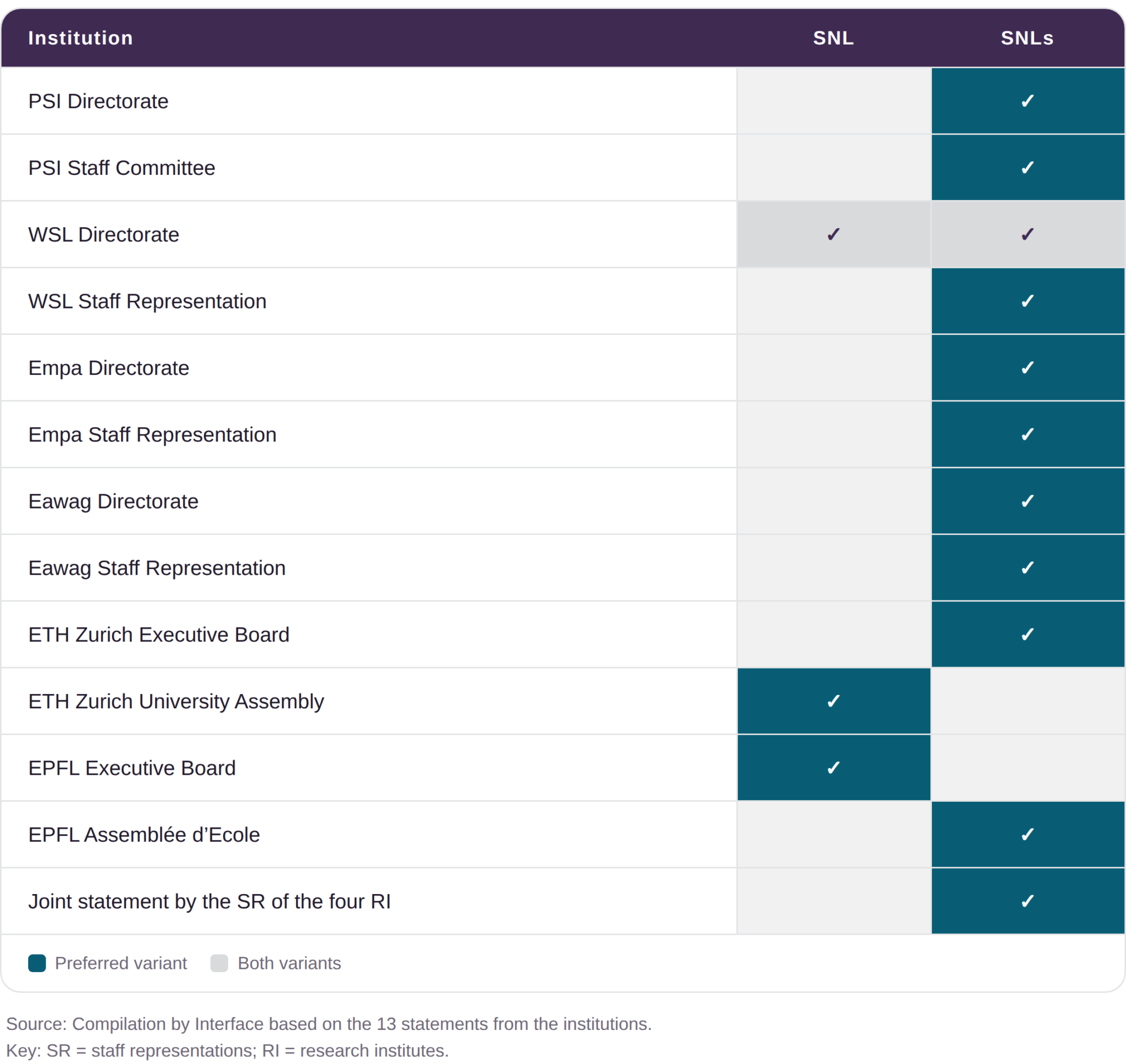
A large majority of the opinions expressed were in favour of the SNLs option. This is viewed as a pragmatic, gradual and comparatively low-risk way to develop the current system further. The advantages mentioned included in particular closer cooperation while at the same time safeguarding the autonomy of the research institutes. According to the results of the consultation, the opportunities presented by the SNL option lie in stronger strategic management, clearer governance and deeper integration of the research institutes. Both options are considered suitable for achieving FIT for the Future’s objectives as set jointly by the ETH Board and the institutions.
The following overview shows the different stakeholders’ preferred options.
Shaping the transformation together
The feedback received also shows that as far as the institutions are concerned, it is not only the choice of option that is important, but also the way in which the transformation process is organised. Key prerequisites mentioned include, among other things, clear objectives, appropriate governance and the early involvement of the employees. All the institutions are prepared to play a constructive role in shaping the ongoing development process.