

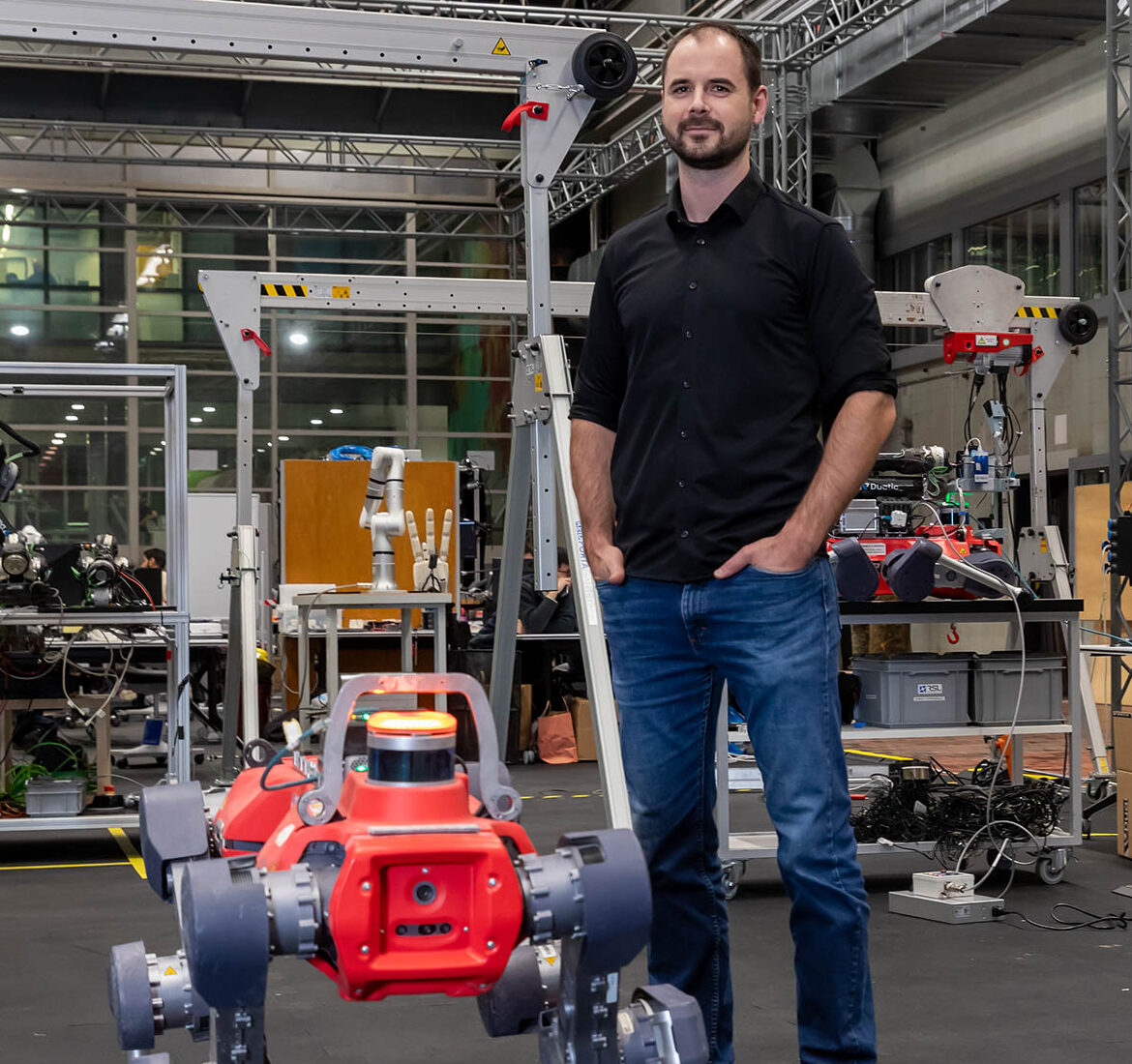
Robotics for the world of tomorrow
In Zurich-Oerlikon, a dog-like robot from the ETH Zurich spin-off Rivr delivers food, while ANYmal inspects refineries and chemical plants and reports leaks or irregularities to the control centre. The research behind these developments comes from the Center for Roboticsat ETH Zurich, led by Marco Hutter. And the robotics researcher is thinking further – into space.
Dull, dirty and dangerous: jobs of this kind will be done by machines instead of people in the future – at least if Marco Hutter has his way. The mechanical engineer heads the Center for Robotics at ETH Zurich (ETH RobotX) and has been working with moving machines for a long time. For this Master’s thesis in 2009, he built a small robot that could jump. It was later joined by a four-legged friend, who initially ran “more badly than well”, as he recalls. That’s all in the past: the robots from the RobotX innovation centre have long been climbing over obstacles. They are as agile and manoeuvrable as their animal role models.
“Robotics is ultimately the continuation of automation, except that today, the systems are not tied to the factory floor.”
Professor Marco Hutter, Leiter von RobotX an der ETH Zürich
“Robotics is ultimately the continuation of automation, except that today, the systems are not tied to the factory floor,” says Hutter, professor at ETH Zurich. His robots can see, hear and react independently. ANYmal, probably the bestknown model, checks valves, measures temperatures and detects anomalies in power plants, mines or chemical facilities. “At ETH Zurich, we show what is technically possible,” he emphasises. “The rest
is up to industry or our start-ups.”
He speaks as a researcher who has the practical
applications in mind, but above all wants to tackle unsolved problems. “We do basic research that is designed to bring direct benefits.” This is precisely the concept behind RobotX, a centre that brings together mechanics, electronics and computer science – and integrates architecture, medicine or environmental sciences as required. “The more skills robots have, the more disciplines are interested in them. These developments also respond to a major social need,” says the head of RobotX.
But there is also scepticism in society
But there is also scepticism in society: people are afraid of a world in which machines make their own decisions. “New technologies have always triggered fear,” says Hutter. “And yet humans have adapted every time.” At the moment, it is probably artificial intelligence that requires the most adjustments. Even in the early days, Hutter used machine learning to programme the robots. But a
great deal has happened since then. Today, the robots are controlled by neural networks. A robot that learns how to move over complex obstacles in a virtual simulation can then do the same in the real world. Autonomy has also improved significantly: the robots can now download a map, interpret the terrain and work out for themselves how to navigate through the world. Largelanguage and large-vision models that have been trained with vast amounts of text and video data from the Internet are increasingly being used. “Our world is very complex, so we can’t manually programme the robot’s behaviour for every possible situation.”
Advances in AI and hardware have also greatly accelerated the development of robotics. In Switzerland, we can sometimes barely keep up with the pace of putting high-tech inventions into practice and scaling them up. “The world is evolving very fast,” says the researcher. While huge robotics centres are being set up in China in a very short space of time, and billions are being invested in robotics start-ups in the USA, it often takes a little longer here, and you have to think on
a smaller scale. The new RobotX test hall at ETH Zurich took around ten years from planning to occupation, for example.
Nevertheless, the professor believes in Zurich as a location for robotics. RobotX is a magnet for talent, and Switzerland is a place where long-term thinking is possible. “ETH Zurich gives us freedom and trust, which are among the most important prerequisites for successful research groups,” he says. Research, especially into hardware, takes time. “If we’d had to stop after three years, robots like ANYmal or start-ups like ANYbotics wouldn’t exist today,” says Hutter. And he has clear ideas about the development of robotics: machines are becoming more versatile and intelligent – and are penetrating new areas, such as medicine, agriculture and space. “We are currently building a quadruped to climb into a lava tube on the moon,” he says. “It’s not a gimmick. It’s about making new scientific discoveries and creating the conditions to enable us to potentially live on other planets one day.”
ETH Zurich in general, and initiatives such as RobotX in particular, not only strengthen Switzerland’s position as a centre for research but also as a hub for science enormously. This enables Zurich to attract renowned companies or international research institutions such as the “Robotics and AI Institute” (RAI).
And he has clear ideas about the development of robotics: machines are becoming more versatile and intelligent – and are penetrating new areas, such as medicine, agriculture and space. “We are currently building a quadruped to climb into a lava tube on the moon,” he says. “It’s not a gimmick. It’s about making new scientific discoveries and creating the conditions to enable us to potentially live on other planets one day.” His dream is to see a robot conducting autonomous research on the moon in ten years’ time.